Running a Swiss Company From Abroad: Tax and Management
 Uzunov Team
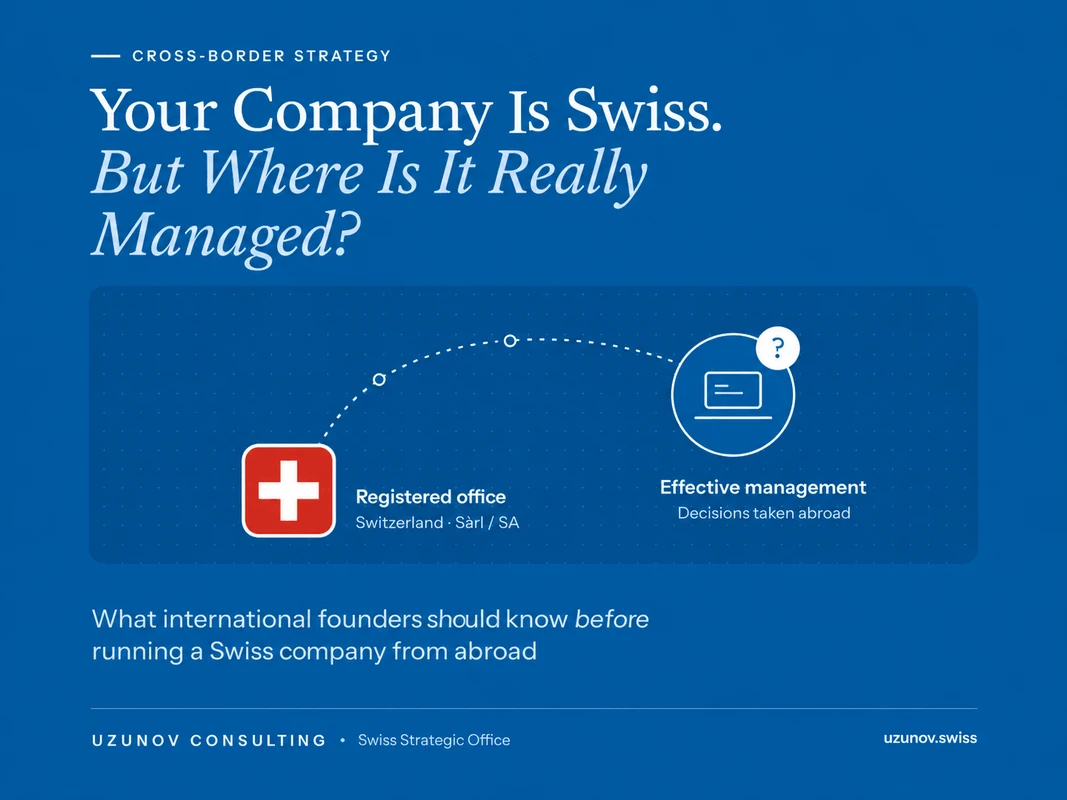
What international founders should know before running a Swiss company from abroad
A founder establishes a company in Geneva.
The company has a Swiss registered office, a Swiss bank account, Swiss accounting and perhaps several Swiss clients.
A few years later, the founder moves to Milan, Paris, Dubai or another international hub.
The company has not formally moved. But the founder has.
Meetings are now held from abroad. Contracts are negotiated there. Payments are approved remotely. Strategic decisions are made from a home office, an apartment or another company office outside Switzerland.
At first sight, this may appear to be a personal relocation issue. From a tax perspective, however, another question becomes increasingly important:
Where is the company actually being managed?
For internationally mobile entrepreneurs, this question should ideally be considered before the relocation rather than after.
A Swiss Registered Office and Effective Management Are Not the Same Thing
Under Swiss domestic tax law, a company is subject to Swiss tax by reason of personal affiliation if either its registered office or its effective management is in Switzerland. The scope of that taxation remains subject to statutory exclusions for foreign business operations, permanent establishments and real estate, and to any applicable tax treaty. [1]
The distinction matters. A company’s registered office is relatively easy to identify: it appears in its articles of association and in the Commercial Register. Effective management is more factual.
Swiss case law looks at where the company’s ongoing business is actually directed. Routine administration and occasional board oversight are not the same as effective management. Where management is spread across several locations, the focus is on its centre of gravity. [2]
For a business whose founder, employees and management are all based in Switzerland, the distinction may not create much difficulty. For an internationally mobile founder, it can become considerably more important.
Consider an illustrative example. Daniel owns 100% of a Geneva-based IT consulting company. For several years, he lived and worked in Switzerland. He then relocates to Italy.
The company’s registered office remains in Geneva. Its accountant remains Swiss. Its invoices continue to show the Geneva address. But Daniel now spends most of his working week in Milan. He negotiates important contracts there, decides which clients the company will accept, approves major expenditure and determines the commercial strategy.
The fact that his company remains Swiss is relevant. It is not necessarily the end of the analysis.
Your Personal Relocation Can Change the Company’s Tax Position
Entrepreneurs understandably concentrate first on their personal position when moving abroad: where they will become tax resident, how their salary and dividends will be taxed, what will happen to their Swiss pension, and how their investments should be structured.
Those questions are important. But an owner-manager should add another one: what does my relocation change for my company?
Keeping the statutory seat in Switzerland preserves a Swiss domestic tax connection. It does not prevent the founder’s destination country from applying its own residence tests to the company. Both countries may therefore regard the same company as resident under their respective laws. [1],[3]
The applicable double taxation agreement then becomes central. Some treaties resolve dual corporate residence by reference to effective management; others require the competent authorities to seek an agreement, taking several factors into account. Treaty relief is therefore not something to assume from the Swiss registration alone. The relevant treaty, any amendments and both countries’ domestic rules must be checked. [3]
A Swiss incorporation tells you where the company was legally established. It does not, by itself, answer every question about where the company may be taxed.
The correct analysis starts with the facts and then considers the domestic legislation of both countries and the relevant double taxation agreement.
Corporate Residence Is Only Part of the Question
A company does not necessarily need to become tax resident in another country for tax consequences to arise there. A second concept may be relevant: the permanent establishment.
A permanent establishment can arise where a company carries on business through a fixed place abroad, such as an office or branch, provided the relevant legal and treaty conditions are met. Under the applicable business-profits provision, the foreign country may then tax the profits attributable to that establishment, rather than automatically taxing all of the company’s profits. [3]
A separate route can arise through a person who habitually concludes contracts for the company abroad. Some treaties also cover a person who plays the principal role leading to contracts routinely concluded without material modification. That broader wording is not present in every treaty, so contract authority must be assessed under the agreement that actually applies. [3]
A founder may not rent a foreign office at all. He or she may simply manage the Swiss company from home.
The OECD Home-Office Guidance
In November 2025, the OECD updated its tax-treaty commentary to clarify how foreign home working can create a taxable business presence. Working from home abroad does not, by itself, create a permanent establishment. [4]
The guidance generally treats home working below 50% of total working time for that enterprise, measured over any twelve-month period beginning or ending in the fiscal year concerned, as insufficient on its own. At or above 50%, the full circumstances, including the commercial reason for working there, require examination. [4]
This is interpretative guidance, not a universal exemption or an automatic amendment to every treaty. Its application must be assessed against the relevant treaty and the positions of the countries concerned. It does not settle corporate residence, dependent-agent permanent establishments, payroll or social-security obligations. [4]
The distinction matters particularly for founders. The OECD separately identifies businesses run solely or mainly by one individual: a consultant conducting most of their own enterprise from a foreign home may have a business location there. A founder running the company from abroad should therefore not assume the same outcome as an employee whose occasional remote work is accommodated for personal reasons. [4]
What Matters Is What Actually Happens
Imagine two Swiss LLCs/Sàrls registered at the same Geneva address.
The founder of Company A moves to Italy. The company nevertheless retains a genuine management team in Geneva. Commercial decisions continue to be made there. Employees, operational infrastructure and client management remain in Switzerland. The founder remains shareholder and director but no longer personally runs every aspect of the company from abroad.
The founder of Company B also moves to Italy. But Company B has no meaningful operational management team in Switzerland. Almost every important commercial decision is made by the founder from Milan. Client negotiations take place there. The founder controls banking, pricing, strategy and daily management from Italy.
These hypothetical companies may look similar in the Commercial Register, but their operating arrangements are different. That difference is relevant to the analysis; it does not, by itself, establish either company’s final tax treatment in Italy.
It is also why simply appointing a Swiss-resident director should not be confused with resolving the international tax analysis.
Swiss-Resident Representation Is a Separate Requirement
Swiss corporate law requires an SA to be capable of being represented by a person resident in Switzerland, who may be a board member or a director. For a Sàrl, the resident representative may be a manager or a director. The signing arrangements must satisfy the representation requirement; a Swiss postal address alone is not sufficient. [5]
This means that a founder can generally live abroad while owning a Swiss company, provided the company’s representation requirements are properly organised.
But the representation requirement should not be confused with tax substance. Appointing a person in Switzerland solely to satisfy the statutory representation rule does not, by itself, establish that the company’s effective management is in Switzerland.
The tax question remains factual: who actually runs the company, and from where?
This is particularly relevant for founder-led companies because ownership, directorship and operational management are often concentrated in the same person.
A Founder Moving Abroad Should Review More Than Corporate Tax
Corporate residence and permanent establishment may be the headline issues, but they are not the only ones.
If the founder continues receiving a salary while working abroad, employment taxation, payroll registration and social-security coverage should be reviewed separately. The relevant social-security arrangements are not the same as an income-tax treaty, and their conditions should not be confused with the OECD home-office guidance. VAT registration and related-party pricing may also require a separate review when activities or functions change. [6]
Depending on the destination and the nature of the activity, it may also be necessary to check work authorisation, licensing and other local operating requirements.
This is why a founder’s relocation should rarely be analysed only through the question “Where will I personally pay tax?” There are two analyses running in parallel: the position of the individual and the international footprint of the company. They interact, but they are not the same thing.
Consider the Structure Before the Move
For many founders, none of this means that they cannot move abroad. Nor does it mean that operating a Swiss company while living internationally is inherently problematic.
It means that the structure should reflect the way the business is actually going to operate.
Before relocating, an owner-manager should map where ongoing management will take place, who will genuinely control contracts and banking, which people and functions will remain in Switzerland, and how any regular foreign workspace will be used. That operating picture provides a useful starting point for reviewing the relevant tax treaty and local obligations.
The purpose is not to manufacture artificial Swiss substance. It is to ensure that the legal, operational and tax structure remain coherent.
Management responsibilities, delegated authority and decision records should reflect what people actually do. A founder who transfers significant business functions abroad needs to understand the consequences, rather than assume that nothing has changed because the company’s Swiss name and address remain the same.
A Growing Issue in an Increasingly Mobile Business World
A personal move and a change in the way a business operates can happen at the same time, without a formal corporate relocation.
Digital tools make that transition administratively straightforward. They do not remove the need to identify where the company is managed and where its activities are performed.
For entrepreneurs, the lesson is not that international mobility should be avoided. It is that the business arrangements should be considered alongside the personal relocation.
If you are preparing to leave Switzerland while maintaining a Swiss business, the useful question is therefore not simply “Can I keep my Swiss company?” In many situations, you can.
The more important question is: how will the company actually operate once I live abroad, and does its legal and tax structure still correspond to that reality?
That is where proper cross-border planning begins.
Questions International Founders Often Ask
Can I live abroad and own a Swiss company?
Generally, yes. Living abroad does not by itself prevent ownership of a Swiss SA or Sàrl. The company must maintain the required Swiss-resident representation. Ownership, management, employment and tax residence are separate questions, and any sector-specific restrictions should also be checked. [5]
Can I manage a Swiss company from another country?
It may be possible, but moving management abroad can affect the company’s tax position. The analysis depends on the actual functions performed, the destination country’s law and the applicable tax treaty, rather than the Swiss registered address alone. [1],[3]
Can my Swiss company become tax resident in another country?
Yes, another country may treat a Swiss-incorporated company as resident there under its own law. The Swiss statutory seat still creates a domestic tax connection, so the relevant treaty must be examined to address any competing residence claims. [1],[3]
Does working from a foreign home office automatically create a permanent establishment?
No. The time spent there and the reasons for using that location matter, but the OECD guidance is not a blanket safe harbour. A founder who is the sole or main person conducting the business needs particular attention, as do corporate residence and contract-related permanent-establishment rules. [4]
Does a Swiss Sàrl or SA need someone resident in Switzerland?
Yes. An SA must be capable of being represented by a Swiss-resident board member or director; for a Sàrl, a Swiss-resident manager or director may fulfil the requirement. However, this does not, on its own, establish effective management in Switzerland. [5]
What should I review before moving abroad with a Swiss company?
Review the actual allocation of management, contract and banking authority, personnel, working locations and remuneration. Then assess corporate residence, any foreign permanent establishment and employment-related obligations for the specific destination. Appropriate documentation should reflect the chosen operating model, not substitute for it.
Scope of this article
This article provides general information, not a country-specific tax opinion. The examples are illustrative. The outcome depends on the company’s actual arrangements, the destination country’s legislation and the treaty in force. Milan, Paris and Dubai are examples of destinations, not interchangeable tax cases.
Legal references and further reading
The numbered references below support the article and FAQ. Statutory references and case details are grouped here to keep the main text readable. Sources checked on 17 September 2026.
1. Swiss corporate tax affiliation
Federal Act on Direct Federal Tax (DBG/LIFD), SR 642.11, Articles 50 and 52(1); Federal Act on the Harmonisation of Direct Taxes of the Cantons and Municipalities (StHG/LHID), SR 642.14, Article 20(1). See also the Swiss Federal Tax Administration, Taxation of legal entities, April 2026, section 3.1.1 (German).
FDTA on Fedlex | Tax Harmonisation Act on Fedlex | FTA corporate tax overview
2. Effective management: scope of the Swiss case law
Swiss Federal Supreme Court, judgment 9C_452/2025 of 23 June 2026, considerations 3.2.1-3.2.2. The decision concerns intercantonal taxation between Zurich and Zug. It supports the Swiss distinction between actual ongoing management, routine administration and board oversight; it does not settle foreign residence or bilateral treaty questions.
3. Treaty residence and permanent establishments
OECD Model Tax Convention, 2017 condensed version, Articles 4, 5 and 7, read with later updates and the applicable bilateral treaty. Article 5(5) contract-related provisions differ between treaties; the 2025 Update records Switzerland’s reservation to use the pre-2017 wording. SIF guidance explains that treaties limit domestic taxing rights and provides the mutual-agreement procedure.
OECD Model Convention | SIF: tax treaties | SIF: mutual-agreement procedure
4. Cross-border home working and the founder distinction
OECD, The 2025 Update to the OECD Model Tax Convention, 19 November 2025: Commentary on Article 5, paragraphs 44.1-44.21, especially 44.8-44.11 and 44.20 (sole or primary operator). Supporting explanation: OECD, Home and away: When does working remotely across borders create a taxable presence?, 26 May 2026. These materials interpret treaty concepts; they do not create a universal percentage exemption.
2025 Update – full text | OECD explanatory article
5. Swiss-resident corporate representation
Swiss Code of Obligations, SR 220, Article 718(4) for an SA/AG and Article 814(3) for a Sàrl/GmbH. SECO’s SME portal explains the resident representative requirement for each form. Representation and effective tax management remain separate analyses.
Code of Obligations on Fedlex | SECO: SA representation | SECO: Sarl representation
6. Separate employment, social-security and pricing reviews
Federal Social Insurance Office, Social security agreements and Telework; Swiss Federal Tax Administration, Transfer pricing, January 2024. Social-security arrangements have their own scope and conditions. No destination-specific payroll, VAT, immigration or regulatory conclusion is provided in this article.
FSIO: social-security agreements | FSIO: telework | FTA: transfer pricing