Geneva Tax Shield: How Expats Can Reduce an Excessive Wealth Tax Burden
 Uzunov Team
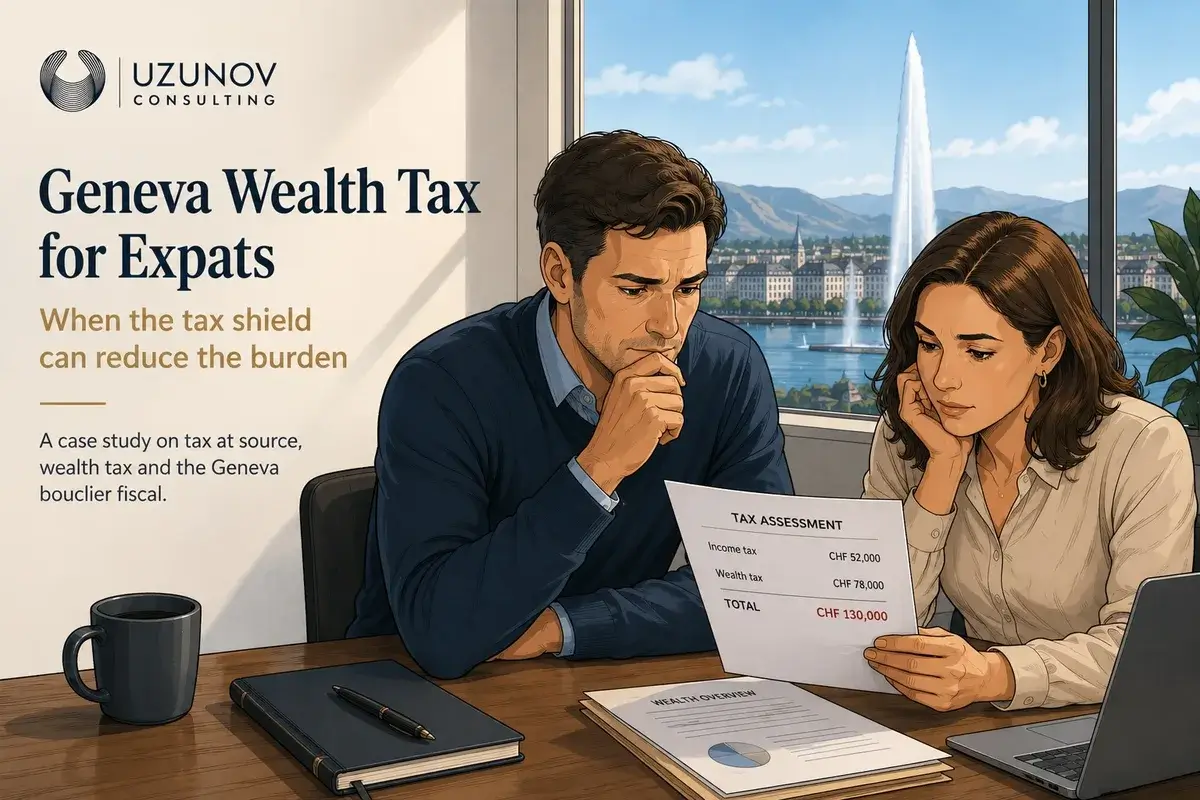
When James and Sofia received their first Swiss tax projection, they were not surprised to see a serious tax bill.
They had moved to Geneva with a clear understanding that Switzerland was not a “no tax” jurisdiction. James had accepted a senior executive position, Sofia managed the family’s investments, and together they owned financial assets accumulated over many years abroad. They expected tax.
What they did not expect was the feeling that the numbers did not match their reality.
When Taxation at Source Tells Only Part of the Story
At first, their Swiss tax situation seemed simple. James was employed in Geneva and taxed at source. Every month, his employer deducted Swiss tax directly from his salary. The payslip showed the withholding tax clearly, and for a while that created a reassuring impression: the Swiss tax system was already taking care of everything.
But taxation at source can be misleading for wealthy expats.
It is mainly a payroll collection mechanism. It captures employment income through the employer, but it does not provide a full picture of the taxpayer’s worldwide net wealth. For a family with foreign investment portfolios, bank accounts, securities or real estate abroad, the monthly withholding tax may only tell part of the story.
That was precisely the issue for James and Sofia.
Their employment income in Switzerland was comfortable, but not extraordinary compared with the value of their assets. A significant part of their wealth was invested for the long term. Some assets generated little annual income. Others were held for capital appreciation rather than regular distributions.
From a balance sheet perspective, James and Sofia were wealthy.
From a cash-flow perspective, the annual tax burden felt unusually heavy.
Income Tax and Wealth Tax: A Distinction That Matters
This tension is familiar to many internationally mobile families settling in Geneva. In many countries, private taxation is driven mainly by income. Switzerland is different. In Geneva, as in most Swiss cantons, individuals are taxed not only on income, but also on net wealth.
For expats taxed at source, this distinction is particularly important. The tax withheld from salary does not usually settle the wealth tax question. If the taxpayer holds substantial assets, an ordinary subsequent tax assessment may be required or advisable, and the final position can differ significantly from the amount deducted monthly through payroll.
In James and Sofia’s case, the wealth tax component created the main issue. Their assets were fully declared, but the resulting cantonal and communal tax burden appeared high in relation to the taxable income actually available to them.
The Geneva Tax Shield — Le Bouclier Fiscal
That is where the Geneva tax shield — the bouclier fiscal — became relevant.
The tax shield is not a favour, an exemption, or a negotiation. It is a legal mechanism intended to limit the combined impact of income tax and wealth tax when the overall cantonal and communal tax burden becomes excessive compared with the taxpayer’s taxable income.
In other words, the question was not whether James and Sofia were wealthy.
They were.
The question was whether the tax burden calculated on that wealth exceeded the legal protection provided by Geneva tax law.
How We Reviewed James and Sofia’s Position
We started with a full review of their position: Swiss employment income, tax already withheld at source, foreign investment income, taxable wealth, securities, bank accounts, deductions, family situation and the projected cantonal and communal taxes.
The work was technical, but the purpose was simple: to determine whether the tax shield applied, and if so, whether the tax return properly reflected it.
This distinction matters.
A high wealth tax bill does not automatically mean that the bouclier fiscal applies. The calculation depends on the legal definition of relevant income and wealth, the applicable thresholds, and the interaction between income tax, wealth tax and withholding tax already deducted. Approximate reasoning is not enough. The analysis must be based on the actual tax return and supporting documents.
For James and Sofia, the review showed that the tax shield could reduce the final Geneva tax burden.
This did not change their obligation to declare worldwide income and assets. It did not remove the wealth tax system. It simply ensured that the protective mechanism provided by Geneva law was correctly applied, taking into account the amounts already withheld at source.
Making the Rules Readable
The result was important financially, but also psychologically.
Before the review, the tax position felt contradictory. The payslips suggested that Swiss tax was already being handled. The final projection suggested a much heavier burden. After the review, James and Sofia understood why the difference existed, how Geneva wealth tax worked, and how the tax shield limited the burden in their specific situation.
That is often where good tax advice creates the most value: not by promising a miracle, but by making the rules readable and ensuring that the taxpayer does not miss a relief mechanism to which they are legally entitled.
The Geneva tax shield can be particularly relevant for expats taxed at source, investors, retirees, entrepreneurs after a liquidity event, or families with significant assets but comparatively limited taxable income.
It should not be assumed automatically.
But it should not be overlooked either.
The Right Question to Ask
For internationally mobile individuals moving to Geneva, the right question is not only:
“How much tax is deducted from my salary?”
The better question is:
“Does my overall Geneva tax burden, including wealth tax, remain within the limits provided by the tax shield?”
James and Sofia’s case is a useful reminder that Swiss tax planning is not only about reducing tax. It is about understanding the system before the numbers become a problem.
Sometimes the monthly withholding tax is only the first chapter.
The full tax story begins when income, assets and cantonal rules are reviewed together.