From Sole Proprietorship to SA/Sàrl: When a Swiss Consultant Outgrows the Independent Model
 Uzunov Team
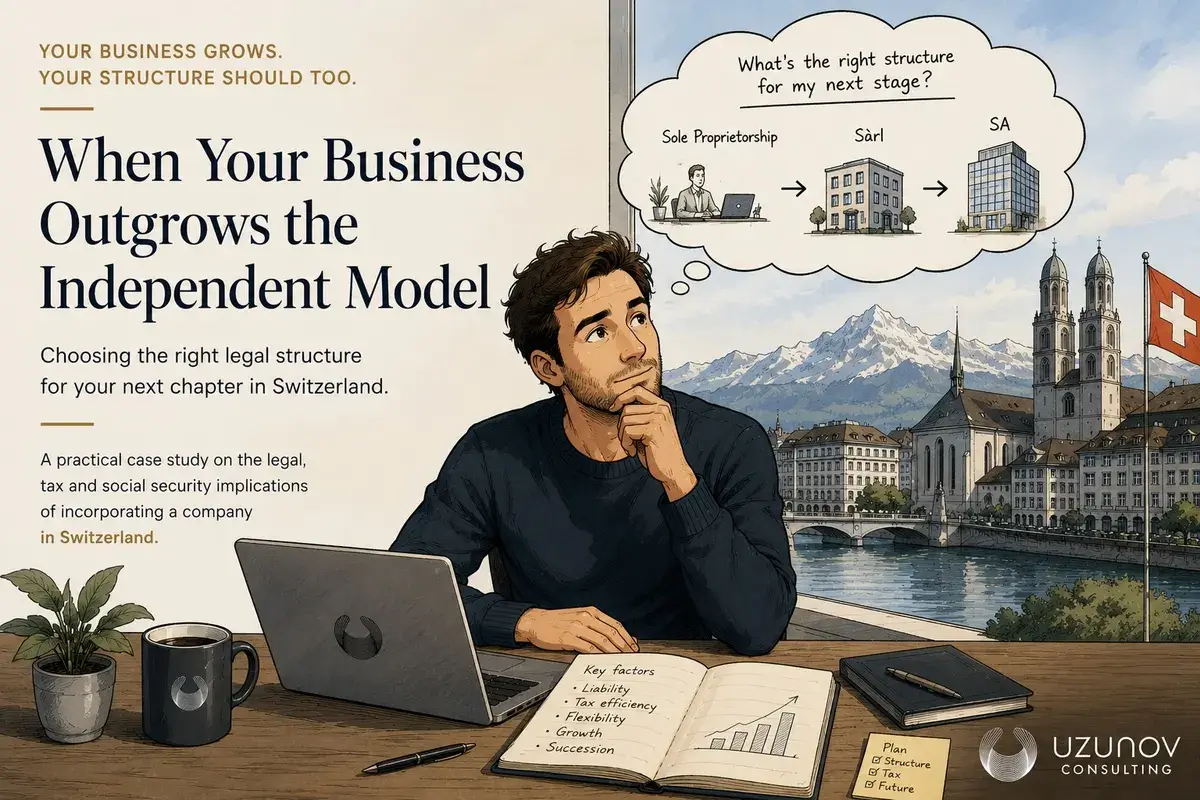
When Marc launched his consulting activity, the choice of structure was obvious.
He was working alone, with a few clients, limited fixed costs and a clear need to keep things simple. Registering as a sole proprietor allowed him to start quickly, invoice his clients directly and manage the business without unnecessary formalities.
For a while, that structure did exactly what it was supposed to do.
The business grew steadily. The client base became more diversified. Mandates were no longer occasional projects, but recurring assignments. Marc was still independent, but the activity had become much more than a side business or a flexible professional setup.
That is usually the moment when the initial structure deserves a second look.
Marc’s question was simple:
“Should I continue as an independent, or should I create a SA or Sàrl?”
It is a question we hear often from consultants, freelancers and owner-managed businesses in Switzerland. And the honest answer is: it depends.
When the Trade-Offs Begin to Shift
A sole proprietorship is often the best way to start. It is simple, flexible and relatively light from an administrative perspective. The trade-off is that the business is not legally separate from the entrepreneur. The profit is taxed directly as personal income, the entrepreneur remains personally liable for the activity, and the same profit is generally relevant for social security purposes.
That is perfectly acceptable when the activity is small or still developing. It becomes more delicate when revenues are stable, risks increase, clients become more institutional, or the entrepreneur wants to build a more structured financial and pension strategy.
The Signals That Pointed Toward Incorporation
In Marc’s case, several signals pointed in the same direction.
First, the profitability of the business had become more predictable. Incorporation should not be decided based on turnover alone. A high revenue figure is not enough. What matters is recurring profit, cash-flow stability and the amount the entrepreneur actually needs to withdraw privately.
Second, the contractual risk had changed. Marc was now signing mandates with larger clients, sometimes with broader liability clauses and more formal procurement requirements. A Sàrl would not magically remove every risk, but it would create a clearer legal separation between the company’s activity and Marc’s private position.
Third, the question of remuneration had become more important. In a company structure, the owner-manager generally receives a salary, with payroll and social security consequences. Dividends may also be considered, but only within a coherent framework. The objective is not to replace salary with dividends artificially. The objective is to define a balanced remuneration policy that is defensible from a tax and social security perspective.
What Changes When You Incorporate
The change is not only formal. It affects the entrepreneur’s obligations on several levels.
From a legal perspective, the activity is no longer carried out personally by Marc, but by a separate legal entity. This means proper articles of association, corporate bodies, commercial register registration, accounting records, and a clearer distinction between private and company assets. Contracts, invoices and insurance coverage also need to reflect the new structure.
From a tax perspective, the profit is no longer taxed directly in Marc’s personal tax return as independent income. The company is taxed separately on its profit and capital. Marc is then taxed personally on the salary he receives and, where applicable, on dividends distributed by the company. This creates planning possibilities, but also requires discipline, particularly regarding salary level, shareholder transactions, expense allocation and withholding tax on dividends.
From a social security perspective, Marc’s status also changes. As an independent, he pays social security contributions on his self-employed income. As an owner-manager employed by his own Sàrl, he generally becomes an employee of the company for payroll purposes. The company must therefore operate salary administration, withhold and pay social security contributions, and consider occupational pension, accident insurance and other employer obligations.
Fourth, pension planning entered the discussion. As an independent, Marc had flexibility. Through a company, he could structure his salary, occupational pension coverage and long-term planning in a more disciplined way. For many entrepreneurs, this point is underestimated until quite late.
Finally, there was the administrative reality. A Sàrl brings more credibility and structure, but also more obligations: bookkeeping, payroll, corporate tax filings, annual accounts, VAT considerations where applicable, and proper corporate governance. A company is not just a tax wrapper. It is a legal and operational commitment.
Getting the Timing Right
After reviewing Marc’s situation, the conclusion was clear: the business had reached the point where a Sàrl made sense.
Not because it was automatically more tax efficient.
Not because every consultant should incorporate.
But because Marc’s activity had become stable, profitable, exposed to higher contractual risk and ready for a more professional framework.
The transition then had to be handled carefully. Existing contracts had to be reviewed. The new company needed to be set up properly. The transfer of the activity had to be documented. Payroll, accounting, VAT, insurance and social security matters had to be aligned from the start.
This is where many entrepreneurs make mistakes. Some incorporate too early, before the business model is mature. Others wait too long, even when the legal and financial profile of the activity has clearly changed.
The right timing is rarely based on one figure alone. It comes from the overall picture.
The Real Question
Marc’s case is a useful reminder: the legal form should follow the economic reality of the business.
A sole proprietorship can be the right structure at the beginning. It is often the most pragmatic choice. But it should not be treated as permanent by default.
When a business becomes more profitable, more visible and more exposed, a Sàrl or SA may provide a better framework for the next stage.
The real question is not:
“Is a company better than being independent?”
The better question is:
“Has my business reached the point where a company is the more appropriate structure?”
For Marc, the answer was yes.
The business had simply outgrown the structure that helped it start.